
Congratulations on three successful PhDs
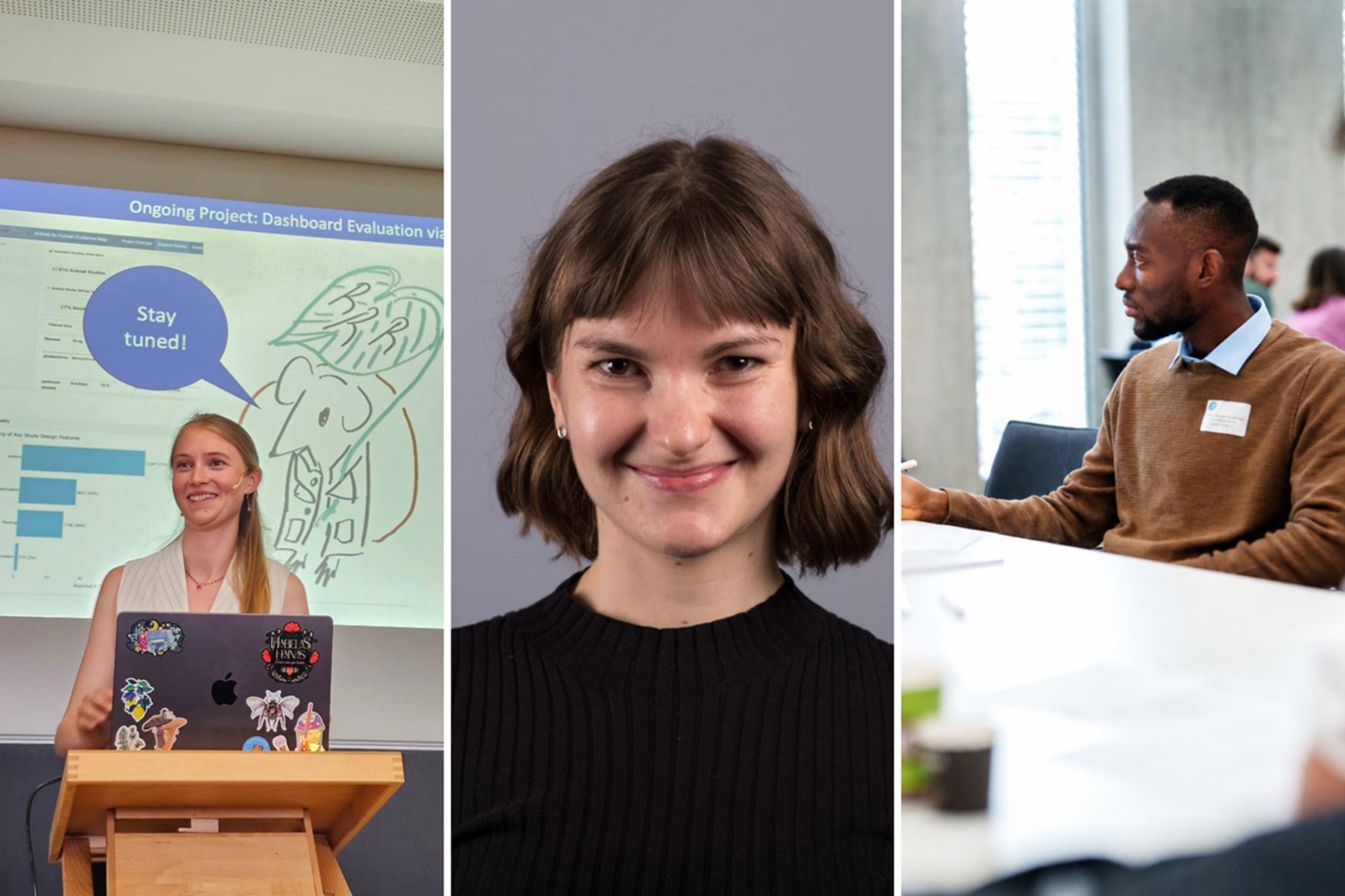
On behalf of NRP 79, we would like to congratulate David Azilagbetor, Doris Zauchner and Simona Doneva on the successful defence of their doctoral theses.
Three researchers, one mission: advancing the 3Rs. Within NRP 79, David Azilagbetor, Doris Zauchner and Simona Doneva have all successfully defended their PhDs – rethinking the ethics of animal experimentation, building a patient-specific bone-on-chip, and harnessing AI to track how animal studies translate to humans. Three very different paths, each bringing science closer to reliable, human-relevant and more humane research – and each a milestone for NRP 79. Congratulations to all three!
David Azilagbetor has rethought the ethics of animal experimentation
Trained as a nurse anaesthetist and advanced health practitioner, David Azilagbetor focuses his work on ethical questions at the intersection of research, healthcare and disruptive technologies. Within NRP 79, he is a member of the project "THINK-3R", led by Prof. Jens Gaab and Prof. Bernice Elger, which investigates how different stakeholders evaluate animal experiments ethically, with the goal of strengthening consistency in Switzerland’s authorisation processes.
This work also formed the basis of his doctoral thesis, entitled "Ethics of Animal Experimentation: Improving Ethical Evaluations, Involving Patients, and Advancing Transparent Governance", which he has now successfully defended. Azilagbetor argues that ethical review should rely on contextual, case-by-case judgement by diverse committees – including people affected by the diseases – rather than quantitative scoring, with decisions reached by consensus. He further recommends expanding the harm-benefit analysis framework to include psychological harm to research staff, making ethical review publicly available and establishing a national citizens’ panel to embed broader societal participation in the oversight of animal research.
What drives David in his research: The pursuit of greater transparency and a more ethically accountable approach to scientific research, shaped by the involvement of affected voices such as patients, citizens and the wider public in research policy-making.
Azilagbetor's thesis is not yet online; once available, it will be findable in the SNSF Data Portal.
Doris Zauchner studied matrix defects in brittle bone disease
Doris Zauchner’s research focuses on bone development, biomaterials engineering and the mechanisms underlying rare bone diseases. Until spring 2026, she was based at the Institute for Biomechanics at ETH Zurich, where she worked in the Biomaterials Engineering Laboratory led by Prof. Xiao-Hua Qin. She took part in the NRP 79 project "Improving Treatment for Patients with Rare Bone Disease", which aims to develop human cell-based models as alternatives to animal experiments in the study of osteogenesis imperfecta (OI) – commonly known as brittle bone disease.
Zauchner has now successfully defended her doctoral thesis "Osteogenesis-Imperfecta-on-a-Chip: An Experimental Tool to Study Matrix Defects in Brittle Bone Disease", in which she developed a human bone-on-chip platform using cells from patients to study OI in the lab. Her thesis brought together three key advances:
a microfluidic chip in which human bone cells form 3D networks and begin to mineralise, mimicking early bone formation
a method to analyse the collagen produced by the cells, making it possible to study the mineralisation defects seen in OI
the application of the platform to cells from both healthy donors and OI patients, revealing patient-specific differences in cell behaviour
Together, this work provides the first patient-specific OI-on-a-chip platform, a human-relevant alternative to animal models, laying the groundwork for personalised disease modelling and therapeutic testing for a condition that currently has no cure.
What drives Doris in her research: The challenge of recreating complex biological processes in engineered systems – and the opportunity to develop human-relevant models that deepen our understanding of diseases and help reduce reliance on animal experiments.
The abstract of Zauchner's thesis is available in the SNSF Data Portal.
Simona Doneva assessed animal-to-human translation at scale
Simona Doneva works at the Center for Reproducible Science and Research Synthesis at the University of Zurich in the STRIDE-Lab of Prof. Benjamin Ineichen, who recently moved to Bern. Trained in business, computer science and data science, she combines expertise in natural language processing with questions of translational research and animal welfare. Within NRP 79, she is a member of the project "Strengthening Digitalisation in Preclinical Research", which uses text mining and artificial intelligence to systematically process data from neuroscience publications – making it freely accessible to scientists to help them better plan animal experiments and advance an evidence-based approach to preclinical research.
Doneva has now successfully defended her doctoral thesis, in which she used artificial intelligence to compare findings from animal studies with those from clinical trials in humans. Her work showed how often results from animal studies actually carry over to humans, how rarely key quality standards such as randomisation and blinding are reported, and how the choice of animal species and sex can bias results and limit how widely they apply. By revealing these patterns across a large body of research, her work helps make preclinical studies more reliable. The data she gathered also feeds an interactive "evidence map" that makes existing findings easier to reuse – supporting better study planning and the goals of the 3Rs.
What drives Simona in her research: The use of artificial intelligence to make scientific evidence more accessible – combining computational methods with biomedical research to advance more reliable research practices that benefit both animal welfare and human health.
Doneva's thesis is available in the SNSF Data Portal.