
Gastruloids: A revolution in embryo research
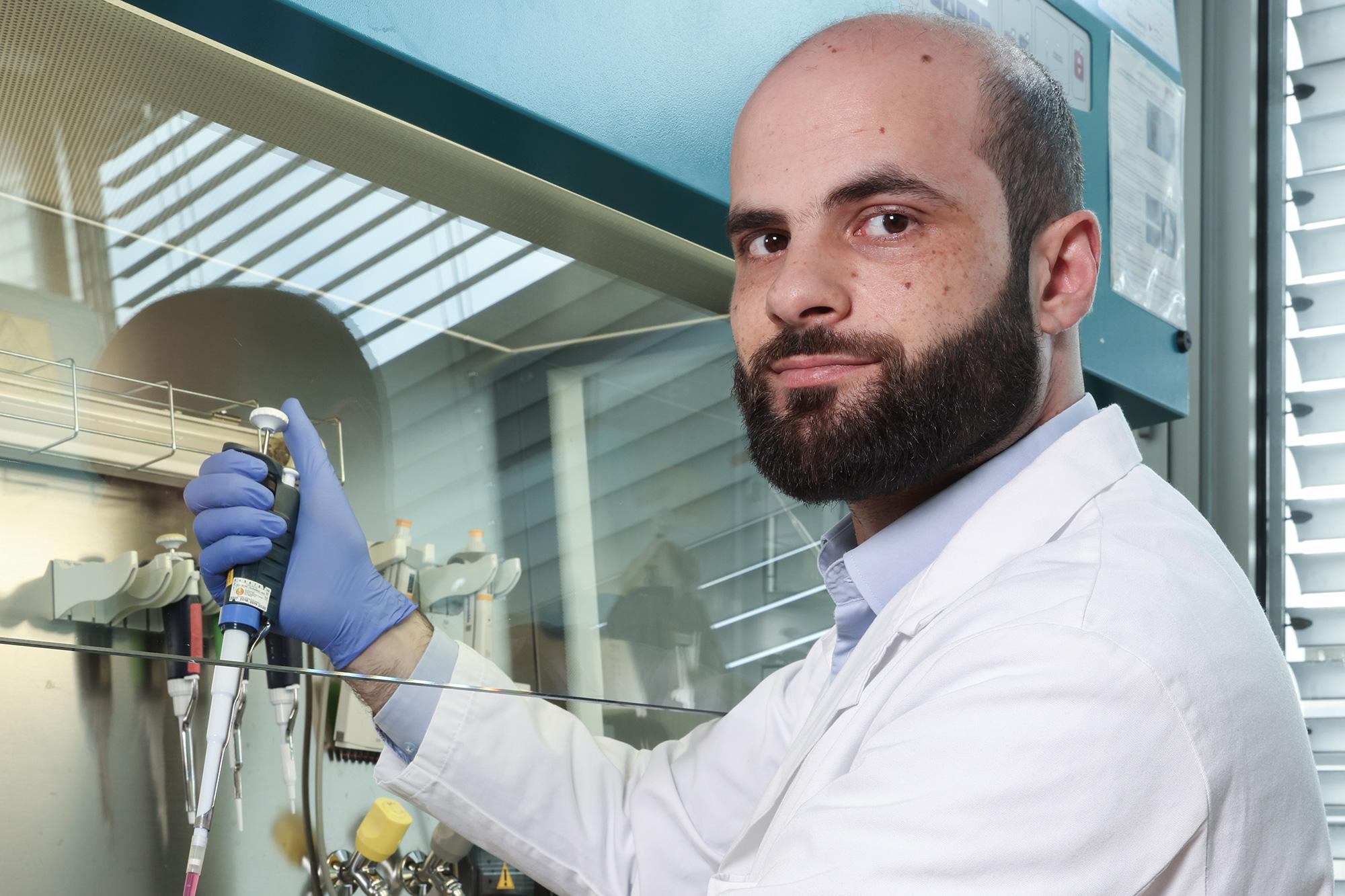
Alexandre Mayran grows gastruloids - lab-made cell structures that mimic early embryo development. Thousands can be made in one afternoon with the aim of reducing animal testing.
Every human being starts out as a single fertilised egg that, within weeks, turns into an embryo made up of millions of specialised cells. Studying this process still requires large numbers of mouse embryos in the lab. Alexandre Mayran, a former group leader at EPFL and now based at INSERM, wanted to change that through his NRP 79 project "Expanding the toolbox of stem-cell derived pseudo-embryos", which concluded in February. His team built gastruloids – three-dimensional, lab-grown cell structures that mimic key features of a developing embryo – and used them to replace animal experiments.
Over the course of the project, Mayran and his team mapped out which of these models exist, what they can and cannot do, and how to broaden their use as alternatives to animal embryos. He revealed how his lab can grow thousands of little bananas in a single afternoon, and how far we remain from a future that no longer relies on mouse embryos.
What exactly is a gastruloid, and how is it different from a real embryo?
Gastruloids were created by Alfonso Martinez Arias, a Spanish and British biologist, in 2014. A real embryo is too complex for many studies, but a gastruloid is simple enough to work with and can be produced efficiently. Gastruloids also lack extra-embryonic tissue, such as tissues formed outside the embryo, like the placenta, which normally gives the embryo its sense of "up" and "down" and where each body part belongs.
Your lab focuses on gastruloids as an alternative to animal experiments. What does that look like in practice?
A single pregnant mouse will produce between ten and twelve embryos that can be used to study genetic diseases. For these embryos to be “useful”, they require the correct genetic makeup, leading to only three to four useful embryos per female mouse. By using mouse gastruloids, we can generate thousands of pseudo-embryo models in a single afternoon, making large-scale testing possible in a developing mammalian system for the first time outside simple cell cultures. And since gastruloids grow outside the uterus, you can monitor their entire development live.
You’ve built collaborations with laboratories across Europe. What did that network look like in practice, and why was it so essential for your research?
I’ll give you an example: A key collaboration was with Thomas Gregor's lab, which built a tool that automatically analyses gastruloid images. This is necessary because large-scale screening produces millions of images. Far too many to analyse by hand. Their tool can automatically recognise shapes and structures in images. AI-driven analysis truly empowers gastruloids for large-scale projects.
Your project wrapped up in February. What was the most surprising challenge along the way?
The real challenge was reproducibility. Early on, working with Thomas Gregor's lab, we found that gastruloid shape varied a lot. Our success rate, that means, how many gastruloids came out the right shape, was already good: 70 to 80 percent. Even so, we wanted more consistency, so we spent a lot of effort fine-tuning culture conditions. Sometimes this meant small details, like using an incubator with several small doors instead of one big one. We're not there yet, but we can now generate gastruloids reliably and at high efficiency.
Could these models later on help test whether drugs are safe during pregnancy?
I'd say yes and no. I wouldn't trust a preclinical study that relied only on a test done in gastruloids. You can build these structures from human embryonic stem cells, or from human adult cells reprogrammed to behave like embryonic ones. This does open the door to evaluate the potential impact of a drug on human development. But organs and tissues communicate with each other in too many ways for these simplistic models alone to say definitively whether a drug is safe.
For initial screening, though, they're excellent: two or three published studies already use this kind of model for drug toxicity screening. I don't think this replaces animal testing in its current form, but it will substantially reduce the numbers of animals used. It lets you narrow down which drugs are worth testing on animals in the first place, so far fewer animals get tested overall.
What do you wish for a young researcher deciding twenty years from now on how to study embryonic development?
In twenty years we should see a major shift. Currently, an alternative model called "synthetic mouse embryo" truly resembles real mouse embryos, in fact, far more closely than gastruloids. But the production of this model is not very efficient. When that efficiency improves, we could generate mouse embryos at will almost entirely without animals being required. Technologically we’re still very far from making equivalent structures using human cells. Still, the current human "stem-cell-derived embryo models" already require ethical oversight, which is one reason why mouse models will stay relevant.